
The health of wild Pacific salmon relies on research
The Pacific Salmon Foundation’s Salmon Health Program is setting out to solve the mystery of which environmental stressors are leading to declines in salmon survival.
The combined impacts of climate change, 150 years of industrial development, habitat degradation, and introduction of disease-causing pathogens through aquaculture have placed Pacific salmon in peril.
Building on previous research, the Pacific Salmon Foundation has launched a Salmon Health program that will undertake critical research to guide action and evidence-based policy to improve salmon health.
Salmon health: informed action
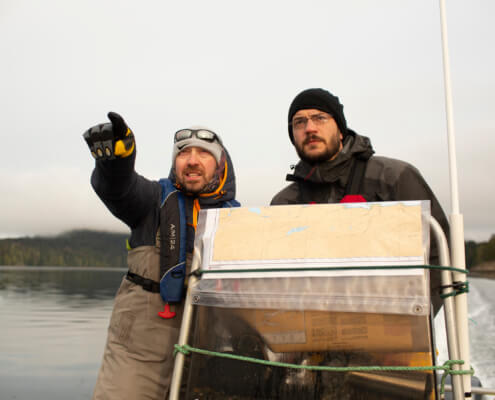
Climate change is widespread, rapid and intensifying, and we know this will create extreme conditions for the health of Pacific salmon, compounded by exposure to pathogens. Building on the findings of the ‘Strategic Salmon Health Initiative’ (SSHI), the Pacific Salmon Foundation has launched a Salmon Health program that will undertake critical research to guide action and evidence-based policy to improve salmon health.
The program focuses on three key areas:
Independent Research + Monitoring of Aquaculture:
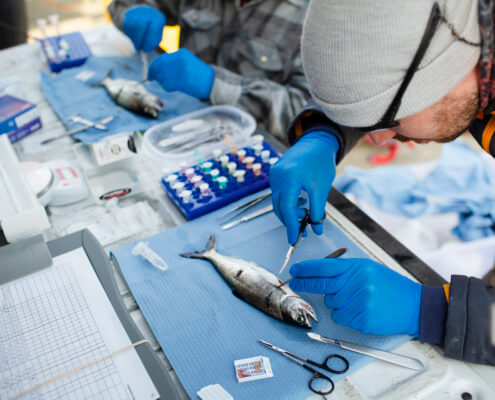
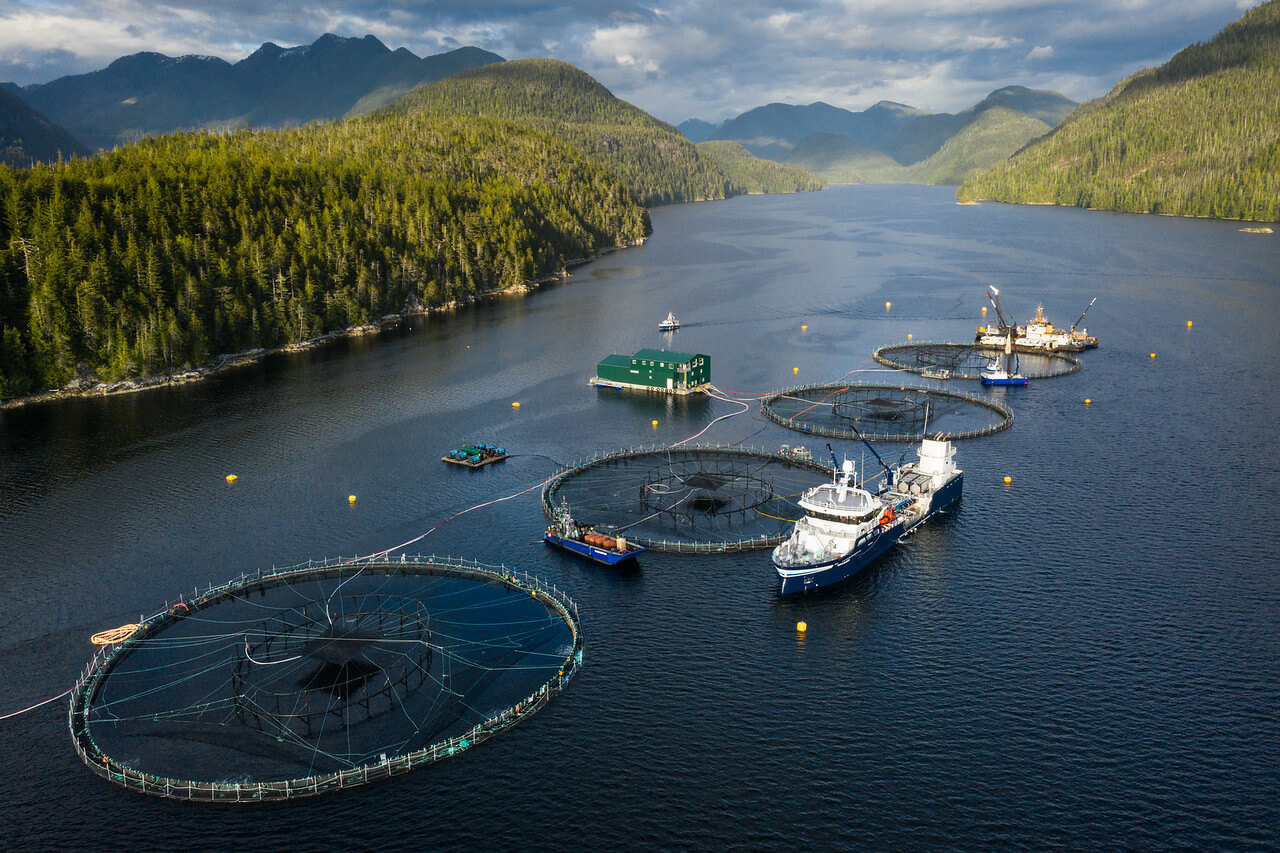
PSF experts are conducting research and monitoring related to sea-lice and pathogen transfer to advance the federal government’s 2025 commitment- deadline to transition away from open net aquaculture. This work will activate environmental DNA (eDNA) monitoring of aquaculture without the need to enter farms. The team will actively monitor the impacts of the removal of farms from the Broughton Archipelago on wild salmon, and will strategically focus research and monitoring on the last remaining major cluster of salmon farms, in Clayoquot Sound, where industry seeks to expand.
Broughton Partnership:
PSF is working with several First Nations on an Indigenous Monitoring and Inspection Program to actively monitor the presence of infectious agents in Atlantic salmon smolts before and after their transfer to open net fish farms in the Broughton Archipelago.
Cumulative Environmental Stressors:
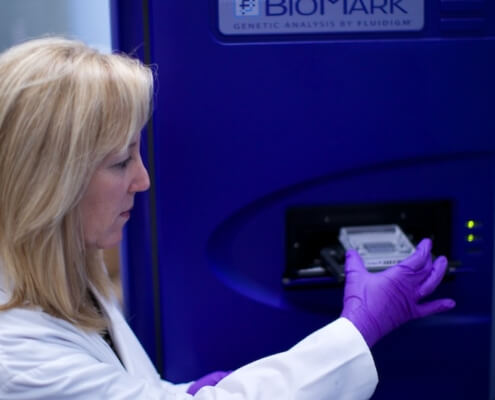
Our team deploys cutting-edge Fit-Chip technology to understand the combined impact of changing environmental conditions on the health of wild Pacific salmon in relation to long-term survival. We drive action to mitigate the specific stressors we identify. This work is informing the broader effort to restore Pacific salmon amidst climate change.
A high impact track record
The Strategic Salmon Health Initiative (SSHI) was a multi-year research project in partnership with Fisheries and Oceans Canada (DFO) and Genome BC, that saw PSF grow to be a global leader in salmon health research.
With our partners, we delivered ground-breaking research, informed regulatory decisions, completely changed the global understanding of how infectious agents are affecting the health of wild Pacific salmon, and helped secure the federal government’s commitment to transition away from open-net aquaculture in B.C. by 2025.
Strategic Salmon Health Initiative:
Salmon farms and salmon disease are a contentious topic in BC because we are passionate about our wild salmon. In the scientific community, there is also a strong belief that disease may be a significant factor in salmon mortality, but not enough is known about what disease agents might affect Pacific salmon in their natural habitats. We’re advancing this work through our Salmon Health Program.
It’s clear, salmon face many health pressures
We must better understand the scale of impact relating to the combined effect of disease and climate change. With more than half of B.C.’s salmon populations in decline, the Salmon Health program will help us understand co-effects of marine stressors, including disease agents, sea lice, ocean temperature and climate pressures.
Interested in learning more?
INFORMATION AND RESOURCES:
- Pacific Salmon Foundation’s position statement: PACIFIC SALMON FOUNDATION POSITION ON AQUACULTURE IN BC « Pacific Salmon Foundation (psf.ca)
- A summary report on the collective body of evidence of risks that open-net pen salmon farms pose to wild salmon, based on scientific research, can be found here.
- PSF Statement on the Government of Canada Transition plan: PSF STATEMENT: Government of Canada outlines next steps in transition from open-net-pen salmon farming in British Columbia « Pacific Salmon Foundation
- PSF Statement to Standing Committee on Fisheries and Oceans (FOPO): Open-net salmon farming in B.C.