Images: Eiko Jones, Fuse Design
Beyond recovery
Pacific salmon are spectacularly resilient. From their first days after hatching to braving the ocean and a gruelling upstream migration, individual salmon routinely beat the odds to survive and spawn. But the collective resilience of salmon is being tested by unprecedented threats, with two-thirds of Pacific salmon below their long-term averages.
“Salmon recovery and salmon resilience go hand in hand. In recent decades, the focus has been on rebuilding populations that have reached critically low abundance, with mixed results. Salmon conservation in the face of climate change requires a more forward-looking approach that strengthens resilience, considering threats and opportunities across a range of climate scenarios,” says Dr. Stephanie Peacock, a scientist at the Pacific Salmon Foundation (PSF).
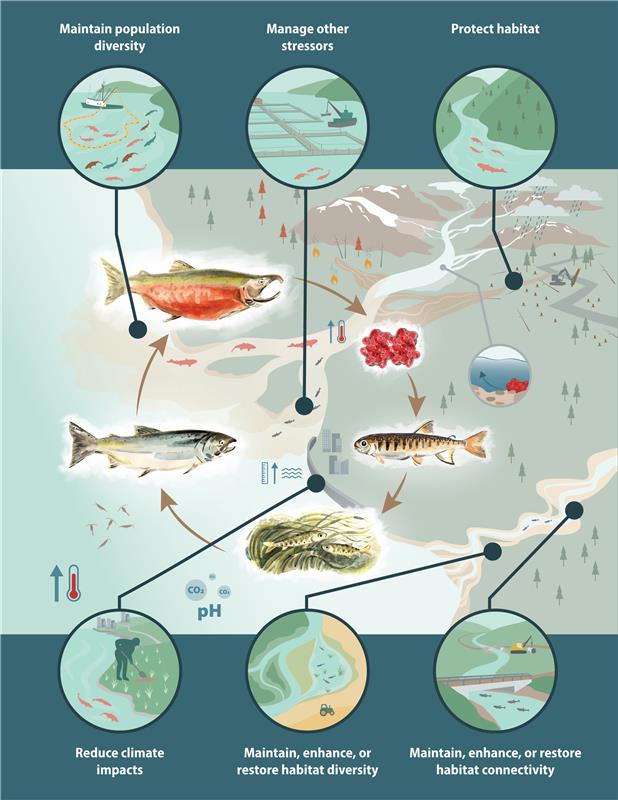
Resilience planning is proactive, aiming to help salmon populations persist and adapt before they experience critical declines. Below, explore resilience pathways to help salmon keep beating the odds, now and into an uncertain future.
What is salmon resilience?
Resilience is a species’ ability to withstand challenges and adapt to changing conditions while still fulfilling its role in the ecosystem. For salmon, this means continuing to serve as keystone species, for instance by transporting ocean nutrients to freshwater habitats. Resilient salmon also support fisheries and important socio-cultural practices for First Nations and communities across B.C. and the Yukon.
What drives salmon resilience
For Pacific salmon as a collective, resilience hinges on several factors, including:
- Abundance: Large populations are better equipped to withstand losses, for example, due to disease outbreaks or natural disasters, without collapsing.
- Productivity: Salmon have a remarkable capacity to replenish themselves – when a high proportion of salmon eggs per nest survive to reproduce, this productivity fuels recovery after declines.
- Diversity: Populations up and down the coast experience different stressors and have developed unique adaptations, allowing some salmon to thrive even as others struggle to adapt to changing conditions.
Having such diversity – at sufficient levels of abundance and productivity – is what allows Pacific salmon to remain resilient in the face of environmental pressures. Across B.C. and the Yukon, there are more than 400 ecologically and genetically diverse salmon population groups known as Conservation Units (CUs).
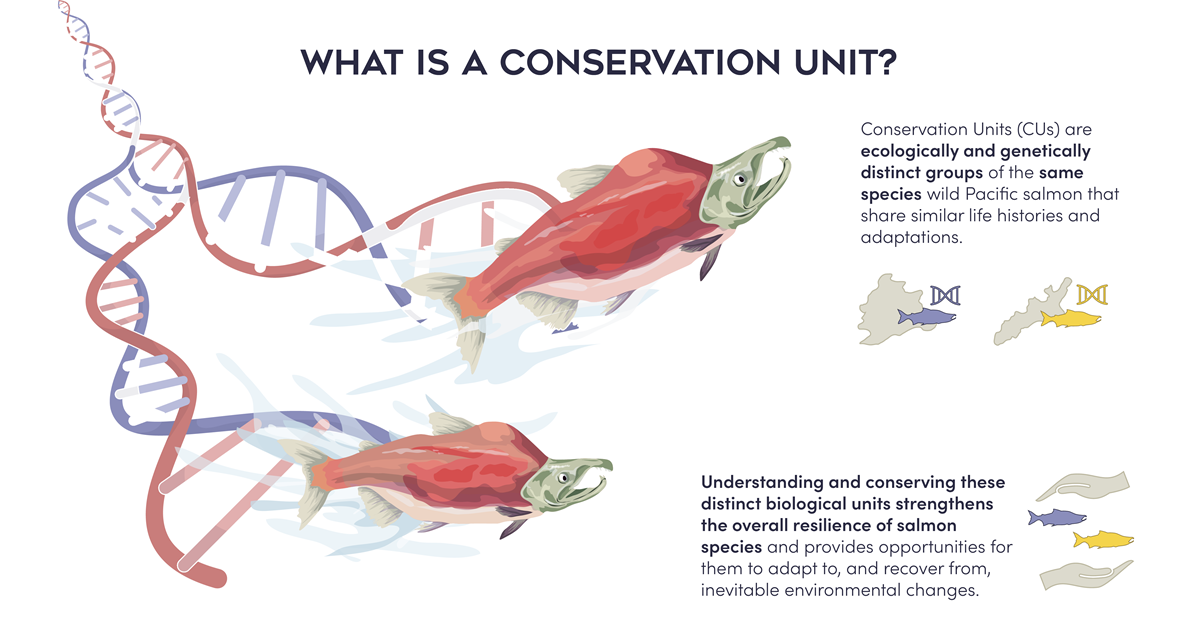
Over thousands of years, some have evolved smaller, slimmer bodies to escape bears in the shallow streams they return to. Others are genetically adapted to enter nearshore and marine habitats as juveniles when food is most plentiful.
“Salmon have a proven track record of being able to thrive in vastly different freshwater habitats, from coastal rainforests to Arctic rivers to inland deserts. There’s also incredible biocultural diversity in how different people interact with salmon,” says Dr. Jonathan Moore, who leads research on salmon resilience at Simon Fraser University.
“This diversity is foundational to salmon resilience given oncoming climate change.”
Assessing salmon climate exposure
The effects of climate change are being felt by salmon at every stage of their life cycle. In some cases, salmon populations have evolved to thrive in habitats that are no longer recognizable.
Warming rivers and lakes can create new habitat and increase salmon survival in northern regions, while also leading to drought conditions and stressing salmon in southern regions. In this uneven playing field, some populations are increasingly more vulnerable to climate impacts than others.
PSF is maintaining updated data and assessments on the biological status of salmon and their habitats across B.C. and the Yukon through the Pacific Salmon Explorer. To future-proof salmon management, PSF scientists are now working with partners to quantify salmon and habitat exposure to climate change and identify pathways to maintain their resilience.
Which species are most exposed to climate change in the Fraser River basin?
In a forthcoming paper (preprint linked here) on salmon climate exposure in the Fraser River basin, Dr. Peacock and others found that lake-type sockeye were the species most exposed to climate change, driven by elevated stream temperatures during their upstream migration to spawn and by their relatively low tolerance for warming ocean conditions. Chinook salmon were the next most exposed, while coho, pink, and chum salmon had relatively low climate exposure.
Understanding these unique patterns in climate exposure across salmon species and populations is the foundation of resilience planning. The earlier vulnerabilities are identified, the better watershed managers and decision-makers can direct efforts to where salmon need help most.
Strategic pathways toward salmon resilience
Regional differences in climate vulnerability call for place-based solutions that integrate three pillars: which populations are most at risk, the status of freshwater habitats, and future exposure to climate change.
“By combining these three axes of information, we can better understand where recovery efforts are more likely to succeed and where investments now – for example, in habitat protection – may pay dividends for future generations,” adds Peacock.
Strategies to strengthen salmon resilience vary by location but broadly include efforts to maintain population and habitat diversity, reduce climate impacts, and manage other stressors, such as forestry or urbanization. By collaborating with First Nations and watershed managers to integrate local data and context, the collective benefits for salmon can be maximized.
“Efforts to recover what has been lost are inevitably more challenging and costly than maintaining species resilience. Salmon have adapted to unpredictable threats for millions of years, but climate change is now outpacing their ability to keep up. It will take all of us to look ahead to future climate scenarios, identify, and strategically pursue opportunities to strengthen their resilience,” says Dr. Katrina Connors, Senior Director of Salmon Programs at PSF.