
PSF updates and expands its flagship State of Salmon Report.
How are Pacific salmon doing?
Which species are faring better, and where?
How are humans affecting salmon abundance?
What is the Path Forward for salmon?
The Pacific Salmon Foundation’s State of Salmon Report offers insights on these critical questions.
First published in 2024 and updated annually, the report synthesizes the best available data across all six species of Pacific salmon, including steelhead, in British Columbia and the Yukon.
The report is the go-to source on how salmon are doing across all major Pacific salmon-bearing regions.
Three editions in, the report’s original purpose has held: it remains the only publication of its kind to bring disparate data sets — from monitoring by individual First Nations to data from the Pacific Salmon Commission — into one accessible place.
The latest report indicates that the state of salmon in British Columbia and the Yukon remains precarious, with approximately half of all populations below their long-term average. Since the previous report, some species showed relatively strong returns in 2025, marginally improving the overall picture. For example, sockeye and pink salmon in the Central Coast and Haida Gwaii shifted from below to above their long-term average abundances.
Experts say these gains demonstrate the ability of salmon to rebound, while emphasizing that they come against a backdrop of widespread, long-term declines in abundance.
“Incremental improvements in the state of salmon give us reason for cautious optimism. They show that, with the right actions and conditions, salmon have the capacity to rebound,” says Dr. Katrina Connors, Senior Director, PSF.
“Yet we must not lose sight of the bigger picture. With 51 per cent of populations below their long-term average abundance, a good year doesn’t undo decades of decline. What it does show us is that recovery is possible — and that sustained action for salmon recovery and resilience must remain a priority.”
Sockeye standouts
Sockeye salmon stand out in the latest report: they are now above their long-term average spawner abundance in every region but one — East Vancouver Island & Mainland Inlets.
In 2025, some sockeye runs exceeded forecasts, including in the Fraser, where returns surpassed pre-season estimates threefold. A different story unfolded in 2026: In a dominant year of the natural four-year Fraser sockeye cycle, the run was downgraded by more than 60 per cent in season.
“Fraser sockeye exceeded expectations in 2025 and are falling short in 2026, reinforcing the need to interpret any single year of data with caution. Changing ocean conditions are making salmon returns increasingly uncertain,” says Dr. Steph Peacock, PSF’s Team Lead of Salmon Assessments.
Fraser sockeye spawner abundance is assessed at 60 per cent above the longterm average, bolstered by the 2025 return. However, total abundance — including harvest and mortality en route to spawning grounds — remains below average.
Steelhead concerns persist
Steelhead have consistently been a cause for concern in PSF’s State of Salmon Reports, and this edition is no exception.
Steelhead are in serious decline in nearly every region. In the Columbia, PSF has assessed steelhead as ‘critically low’ and at risk of local extinction. In 2025, just one natural-origin steelhead spawner was detected in the British Columbian portion of the Okanagan basin.
Some steelhead populations are approaching record lows. In the Fraser watershed, the 2025 test fishery caught no Thompson River summer steelhead — a first in its 40-year history.
In-season reports from the Skeena River suggest returns may be stronger than expected in 2026, but concerns remain. Skeena steelhead abundance has trended downward in recent years, and as recently as 2021, saw their lowest return on record.
Furthermore, sparse steelhead monitoring across the province limits our understanding of the extent and severity of declines.
New additions to the report
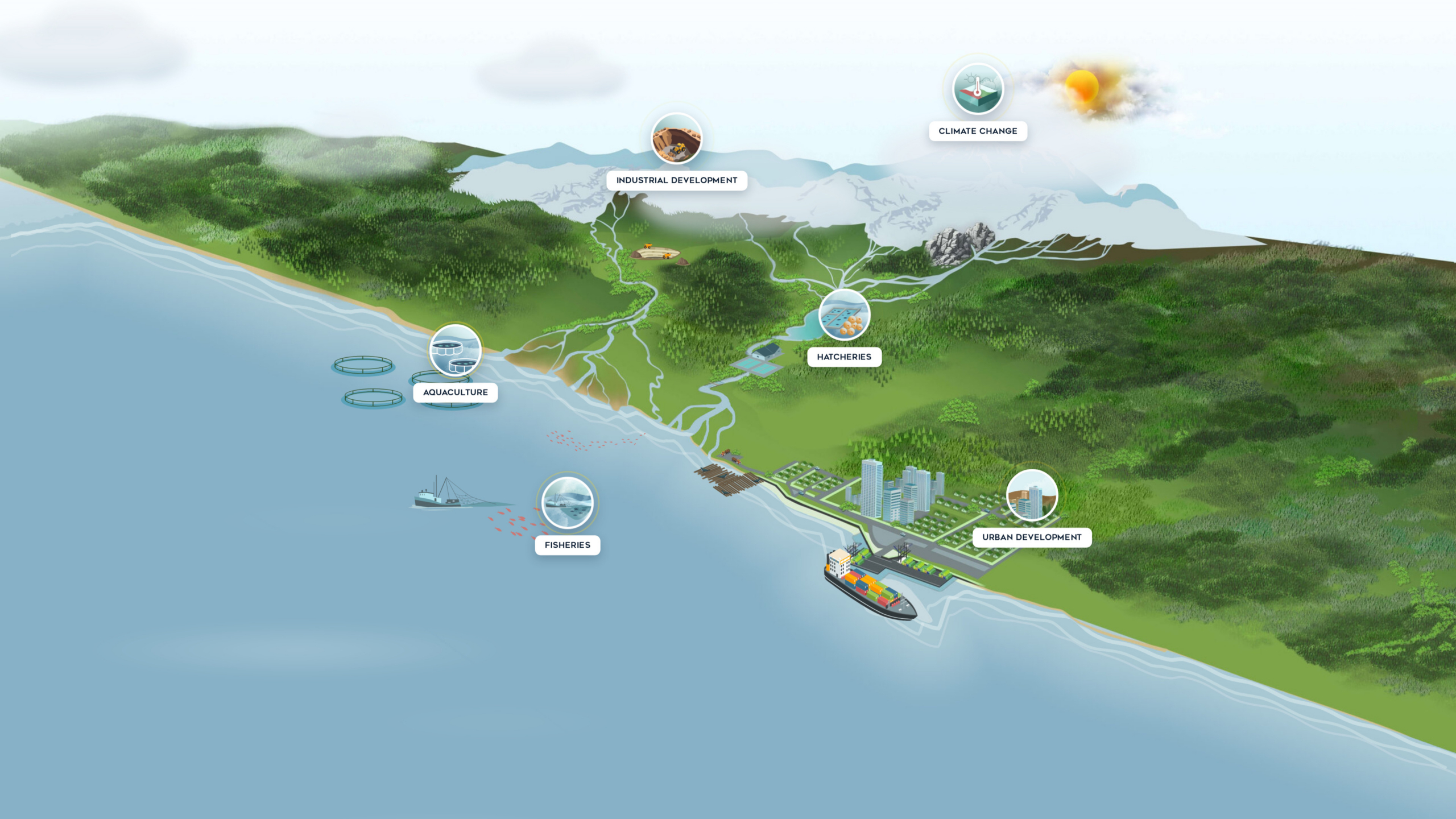
This year’s report also introduces two new content elements. The first is a synthesis of major human-driven factors affecting salmon survival. Across their complex life cycle, salmon face pressures that accumulate and interact. The report examines six of them: climate change, aquaculture, fisheries, hatcheries, industrial development, and urban development.
The 2026 edition also presents a Path Forward, outlining a more coordinated, collaborative approach to salmon recovery and long-term resilience.
“We developed the Path Forward in response to what our reporting has consistently shown: salmon are facing widespread, long-term declines. But the Path Forward is deliberately future-focused and solutions-driven. It shows that there is a way forward and gives us reason for hope about the future of Pacific salmon,” says Dr. Connors.
As the Path Forward concludes: “Salmon have shown an extraordinary capacity to recover. Create the right conditions, and there is every reason to believe they will thrive again.”
Special thanks to the Province of B.C. and Sitka Foundation for supporting PSF’s State of Salmon Report.
