
Viral heart disease far more widespread on B.C. open-net pen salmon farms than previously reported, new study finds
Oct. 8, 2026
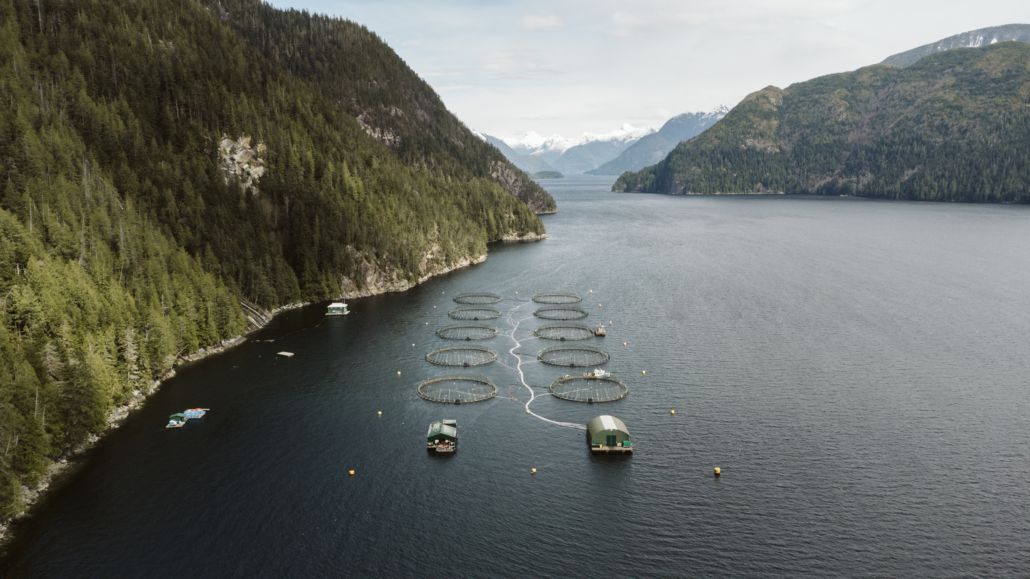
A new study published in the journal Aquaculture has found that Heart and Skeletal Muscle Inflammation (HSMI), a disease caused by Piscine Orthoreovirus (PRV), is far more widespread on open-net pen Atlantic salmon farms in B.C. than previously documented. Furthermore, even if farmed Atlantic salmon don’t have the disease, open-net pens still release the virus into surrounding waters, where it can infect wild salmon.
Researchers diagnosed HSMI in five out of seven farms in the Broughton Archipelago – with nearly 7 per cent of the 749 farmed Atlantic salmon examined showing signs of the disease, as verified by three independent pathologists. This research builds on a 2017 study that also made a farm-level HSMI diagnosis in B.C., suggesting this was not an isolated occurrence and that HSMI is common on B.C.’s open-net pen salmon farms.
The study was conducted as part of the Broughton Aquaculture Transition Initiative (BATI), a plan led by the Mamalilikulla, ʼNa̱mǥis, and Ḵwiḵwa̱sut’inux̱w Ha̱xwa’mis First Nations.
“This study on PRV only reinforces what we have known for decades — these farms are harming wild salmon in our territories. Wild Pacific salmon are a very precious resource for our nation, and it is my responsibility as Chief to protect them. Open-net pens must be removed from our waters and across British Columbia, and the 2029 ban must not be delayed,” says Chief Rick Johnson of Ḵwiḵwa̱sut’inux̱w Ha̱xwa’mis First Nation, co-author of the study.
Piscine Orthoreovirus is currently classified by DFO as non-pathogenic in British Columbia, but this study provides new evidence that it causes disease here. The study’s authors say its pathogenic risk status should be re-evaluated in British Columbia.
“This study adds clear evidence that PRV can cause disease in British Columbia, and that HSMI is more common on open-net pen salmon farms than previously understood,” says Dr. Emiliano Di Cicco, lead author and fish health researcher with the Pacific Salmon Foundation. “We recommend that DFO reassess the pathogenicity of PRV, so that decisions about infectious agents are grounded in the best available science and disease risks are managed effectively.”
Disease common on salmon farms worldwide
Heart and Skeletal Muscle Inflammation (HSMI) is one of the most common diseases occurring on salmon farms in Norway. It has also been identified in most countries that practice Atlantic salmon farming.
Piscine Orthoreovirus (PRV), a viral pathogen best known for causing HSMI worldwide, is native to the North Atlantic Ocean. It was introduced to British Columbia approximately 30 years ago, coinciding with the growth of commercial open-net pen salmon farming in the province.
While HSMI is routinely recognized in other salmon-farming regions, it has not yet received the same recognition in British Columbia.
The authors of the study say that Fisheries and Oceans Canada (DFO) uses different standards for diagnosing HSMI than other countries. DFO’s criteria look for clinical signs or acute mortality spikes, whereas fish affected by HSMI can show no clinical signs, and the disease is known globally as a chronic, low-level condition.
“DFO’s process makes it nearly impossible to diagnose HSMI in British Columbia,” says Dr. Di Cicco. “If DFO’s standards were applied elsewhere, HSMI would appear to be exceedingly rare even in Norway, where it is acknowledged to be common.”
DFO’s Disease Agent Assessment form, which evaluates the ability of parasites, pathogens, and viruses to cause disease in fish, states that PRV is not an infectious disease agent. This assessment was made in 2019.
The Broughton study provides new evidence that PRV causes disease in British Columbia, documenting several HSMI occurrences on active open-net pen farms, with some lasting for months. The authors say DFO should reassess PRV’s pathogenicity and its standards for diagnosing HSMI.
PRV causes unique diseases in Pacific vs. Atlantic salmon
Previous research revealed that PRV is more common at active open-net pen sites in B.C. than at inactive ones, and that PRV spills over from farms to surrounding waters.
The Broughton study builds on this existing research. Using environmental RNA, the authors found that PRV abundance in farmed salmon predicts virus levels in the surrounding water better than the number of fish diagnosed with the disease, suggesting the virus can spread to the surrounding ocean even when the disease itself is under control.
“The virus, PRV, is extremely common in open-net pens. Whether or not farmed Atlantic salmon show signs of disease (HSMI), the majority are carriers of the virus, which has been shown to spread to surrounding waters, where it can infect wild Pacific salmon,” says Hereditary Chief Ho’miskanis and Elected Chief Councillor Don Svanvik of the ʼNa̱mǥis First Nation, co-author of the study.
PRV infection manifests differently in Pacific salmon and Atlantic salmon.
PRV causes HSMI in Atlantic salmon, whereas Pacific salmon show different disease signs from PRV infection, as documented in Norwegian and Chilean rainbow trout, Japanese and Chilean coho salmon, and B.C. Chinook salmon.
Pacific salmon, especially Chinook, infected by PRV may present ruptured red blood cells, which can lead to anemia, inflamed hearts, damaged livers and kidneys, and jaundice. In B.C., PRV has been associated with jaundice/anemia in Chinook salmon, which often spend their first year in coastal bays and inlets where open-net pens are also located. This could increase the chances of Chinook encountering harmful infective agents, such as PRV.
“Active open-net pen salmon farms cannot fully contain the spread of pathogens such as lice, parasites, and viruses, and migrating wild salmon swimming past these farms can become infected. DFO must act responsibly and fulfill its mandate to protect wild salmon,” says Svanvik.
Media Contact
Braela Kwan
Communications Specialist, Pacific Salmon Foundation
bkwan@psf.ca; (604) 664-7664 ext. 1025
About the Broughton Aquaculture Transition Initiative
The Broughton Aquaculture Transition Initiative (BATI) is a plan led by the Mamalilikulla, ‘Na̱mg̱is, and Ḵwiḵwa̱sut’inux̱w Ha̱xwa’mis First Nations. BATI was formed to facilitate shared decision-making on the future of aquaculture in the Broughton Archipelago and the protection of wild salmon. In 2018, the BATI Nations announced an agreement with the Province of B.C. that had 10 of 17 salmon farms in their territories to cease operations by the end of 2022. In 2023, the BATI Nations announced a decision not to consent to the continued operations of open-net pen fish farms in their territories. In the months following, the seven remaining active fish farming operations in the Broughton Archipelago were decommissioned.
About the Pacific Salmon Foundation
The Pacific Salmon Foundation, founded in 1987, is a non-profit environmental organization dedicated to making transformational change for the benefit of Pacific salmon at every scale – from the smallest streams to the open ocean. We work with partners to achieve our vision of healthy, sustainable, and naturally diverse populations of Pacific salmon for the benefit of ecosystems and people for generations to come.
