ENTER TO WIN!

Enter to win a salmon tumbler from Native Northwest. We'll draw a winner on January 16, 2026.

Name(Required)
Email(Required)
Please confirm that you are a current monthly donor:

$1.3 m project to revive Vancouver Island Chinook

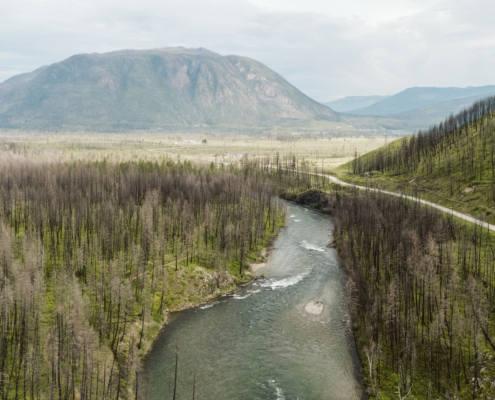
A threatened population of Chinook salmon will get a major boost from significant restoration work in the Nootka Sound region of Vancouver Island. The new project is improving spawning habitat at the outflow area of Muchalat Lake, a remote area about 90 kilometres west of Campbell River.

Restoration efforts aim to recover the local Chinook population, which has suffered from increased flows brought on by heavy logging practices and climate effects that have degraded the Muchalat and Gold River watersheds.

It’s anticipated that improved spawning habitat will significantly increase the number of fish annually spawning at the site to about 1,000 to 2,000 adult Chinook salmon. 

Questions? Ask Krysten!

If you have questions about the impact of your monthly gift or if you’d like to talk to us about any of the work being done by the Pacific Salmon Foundation, please reach out to Krysten Maier, Development Officer, kmaier@psf.ca, 604-664-7664 ext. 1021

Salmon School

  • How many distinct salmon populations are the in B.C.?

    There are more than 9,000 salmon populations (species and stream combinations) in B.C., organized into about 450 conservation units applied in resource management.

  • How many eggs does a female salmon lay?

    Females lay thousands of eggs, usually between 2,000 and 10,000 depending on their size and species. Unfortunately, at present less than one percent of these eggs survive to the next generation.

  • What is the biggest Pacific salmon species?

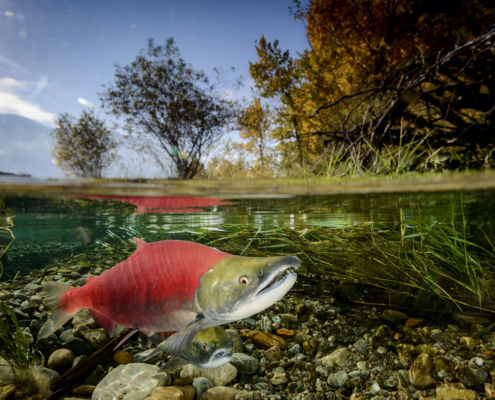
    Chinook, also known as Tyee (meaning King), generally weigh between 30 and 40 lbs. They live the longest of Pacific salmon (up to eight years) and prefer larger river systems. Their size and splendour make them wonderful catches, but it also contributes to their scarcity relative to other Pacific salmon.

  • How long can a spawning salmon go without eating?

    Once salmon return to freshwater from the marine environment to spawn, they do not eat. Adult spawners can go 6 months without eating, all the while transferring body fats into their gametes for reproduction.

  • What effect does warming water temperatures have on salmon?

    As water temperatures rise, salmon can suffer from decreased swimming performance and early signs of stress and slow migration—it’s like trying to run a marathon in a sauna! With an increase of a couple more degrees, salmon are more prone to pre-spawn disease and even mortality.

  • How many Chinook salmon can an adult killer whale eat each day?

    Chinook salmon makes up at least 80% of Southern Resident Orcas’ diet. An adult must consume between 18-25 salmon to meet its daily energy requirements. The whales’ ability to produce offspring is also highly dependent on salmon availability.

News & Updates

Salmon come to life in Yukon classrooms

,
Rivers to Ridges, a Yukon-based social enterprise, is working to reconnect local youth with salmon and their watersheds through outdoor education. With support from PSF, their educators are collaborating with Indigenous knowledge holders to co-develop three new salmon-focused educational resources.

The latest on open-net pen salmon farms in B.C.

,
With three critical years left until the ban on open-net pen salmon aquaculture takes effect, PSF is building on more than a decade of peer-reviewed science. By continuing research on risks of pathogen transmission from farmed to wild salmon, PSF is helping shape an evidence-based path forward.

A decade of tracking salmon biodiversity

,
Over the past 15 years, PSF has consolidated fragmented data into a publicly accessible tool, the Pacific Salmon Explorer. Beginning with the Skeena watershed in 2016 and expanding most recently to the Yukon in 2025, the Explorer now spans all major Pacific salmon-bearing regions in Canada.

Meet Farlyn Campbell, Salmon Stamp Artist

,
An experienced skipper, salmon fisher, and researcher based in the Discovery Islands, Farlyn Campbell is the artist behind the 2026-27 Salmon Conservation Stamp.

New boat gives everyone, everywhere the chance to fish

,
A new, fully accessible boat, aptly named Everyone Everywhere, is removing barriers to the outdoors for people with disabilities in British Columbia.

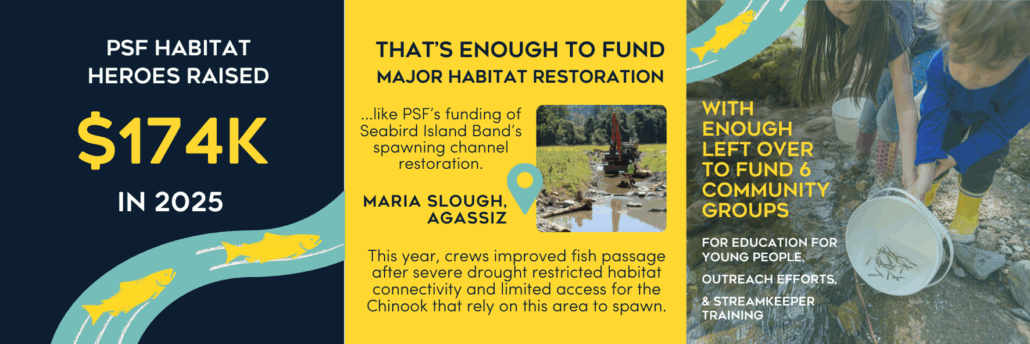
Bringing Chinook Back to Maria Slough

, ,
With support from PSF’s Community Salmon Program in 2025, Seabird Island Band and DFO crews redistributed spawning gravel throughout the channel and added boulders and logs to cool the water, boost oxygen, and keep flows moving through summer heat.