The lab
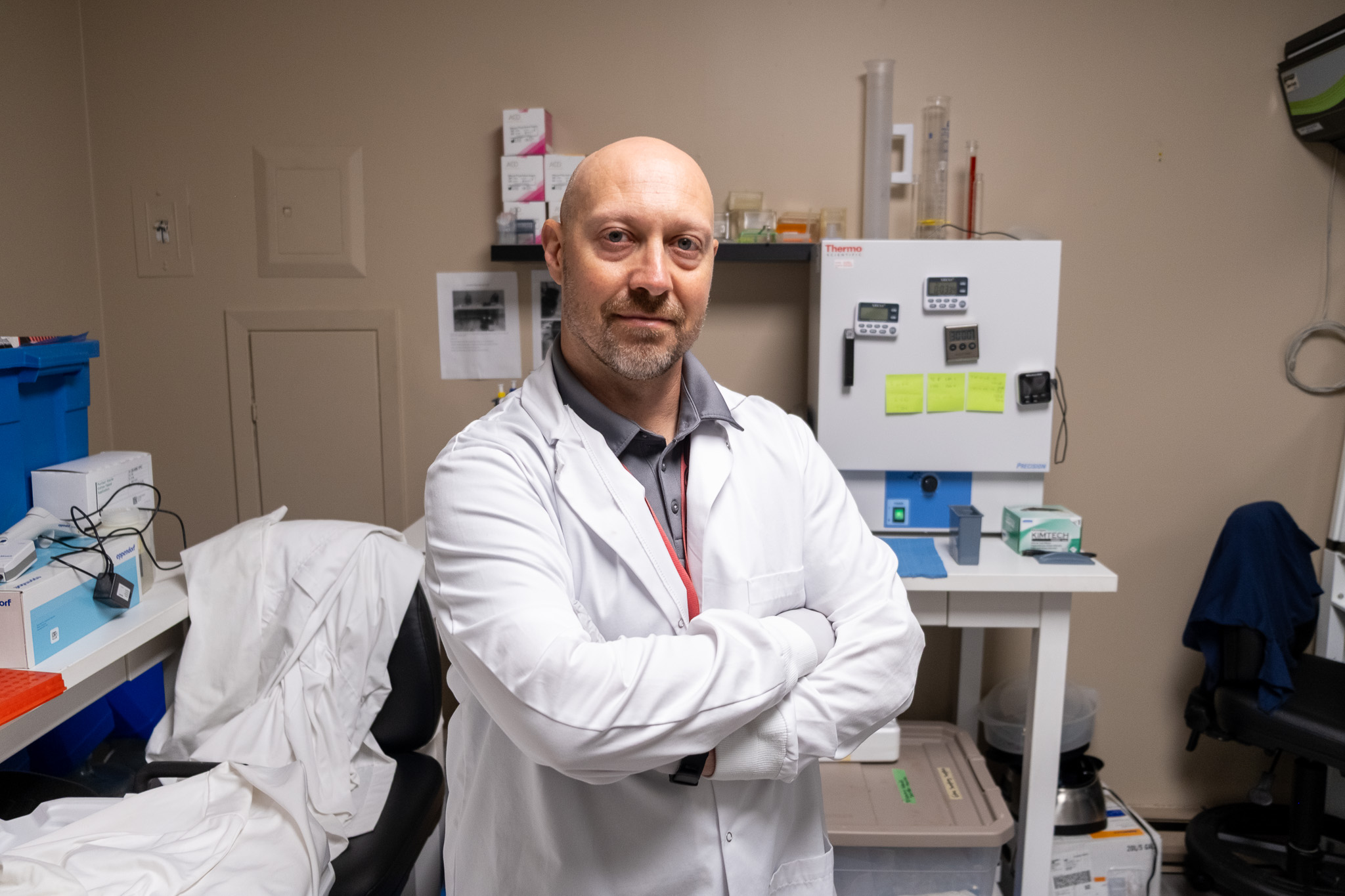
In a small, somewhat cramped lab in Nanaimo, Dr. Emiliano Di Cicco, a fish health researcher with the Pacific Salmon Foundation (PSF), is investigating one of the biggest questions in salmon science: why do so many salmon die in the ocean before they can return to their natal rivers?
More specifically, Emiliano is continuing his multiyear research into Tenacibaculum, a common marine bacterium known to cause ulcers and mortality in infected fish. But before he can study it, he must first make the bacterial colonies visible.
“People are often surprised by how hands-on this work is,” says Emiliano as he carefully sets out glass slides for a staining procedure. “It’s almost artisanal.”
The procedure involves applying a staining agent formulated to bind to a specific bacterial target. “It’s a cascading event, where one bond becomes two, then four, and so on, in a way that eventually makes it possible to visualize a spot, a red spot in this case, in the slide when you look at it under a microscope.”
Laid over thinly sliced samples of fish tissue, those red spots reveal where the bacteria are located. If they line up with the lesions, it supports the inference that the infection is what caused the damage.
The work is repetitive and meticulous. Each staining procedure involves treating 10 to 15 tissue slides at a time, with more than 50 separate steps carried out over two days of staining. The stained slides are then imaged, uploaded, and analyzed. The process is repeated week after week until every sample has been run. “I usually put on a podcast to keep the energy up,” he says.
Slide by slide, lining up red spots with wounds, Emiliano is working toward an answer to a much bigger question: how are pathogens contributing to salmon mortality in the ocean?
A salmon mortality mystery
Beginning in the 1970s, Pacific salmon’s marine survival rates – the number of fish that survive the migration from river to ocean and return as adults – sharply declined. PSF’s Habitat and Ecosystem Science team has been working to determine the causes, including through a Salmon Health division investigating the role of pathogen exposure in salmon mortality.
But studying pathogens in migratory, wide-ranging fish like Pacific salmon is no easy feat.
“Usually, once a salmon is infected and showing signs of disease, they either get picked off by a predator or they are not able to catch their own prey and starve. Or, they may actually die because of the disease,” says Emiliano as he cues up another round of samples for staining.
His samples come from challenge experiments, where fish are placed in tanks, exposed to an isolated bacterium, and then sampled. “The idea is to recreate in the lab the development of the disease in the ocean.”
That work follows directly from a recent study in Scientific Reports, co-led by PSF and UBC, which documented tenacibaculosis in wild Chinook for the first time. The study concluded that confirming the mechanisms behind the outbreak would require exactly what Emiliano is doing now: culturing the bacterium from wild-caught fish and running controlled challenge experiments.
A threat within our control
Emiliano puts a slide under the microscope and pulls it up on screen. He points out a vivid red cluster of bacterial growth.
Asked how disease ranks among the threats facing wild salmon, he notes there are still many unknowns, but with each experiment, another piece of the puzzle snaps into place.
“What we know so far is that Tenacibaculum can have an important impact on wild fish. And from the recent paper we published, we can see that it can cause disease in wild fish. From previous research, we also know that higher levels of these bacteria are often found around open-net fish farms.”
Research from PSF’s Salmon Health team has helped clarify those risks. One study found elevated pathogen levels in Fraser sockeye migrating past salmon farms in the Discovery Islands. Another paper warned that warming waters from climate change may compound the threat, as some disease-causing bacteria proliferate at higher temperatures.
The federal government has committed to ending open-net pen salmon farming in B.C. by 2029, a deadline now three years out.
A breach in salmon defences
Tenacibaculum, Emiliano notes, is an opportunistic pathogen found in oceans worldwide. Salmon are usually well protected by their scales and a layer of mucus they shed regularly, but that barrier can be compromised by predation, angler handling, abrasion from fishing nets, and, on fish farms, sea lice and the treatments used to remove them. Damage from any of these can create a port of entry for infection.
Anglers hoping to give salmon the best chance of survival should look at the guidelines from Dr. Scott Hinch’s study, research which PSF helped support.
“By handling fish in the correct way, we can help the fish have the best chances to survive when doing catch and release,” says Emiliano.
The scientist and the angler
Emiliano began fishing with his uncle and godfather in Italy as a young child. On his first visit to British Columbia in 2007, he took a guided trip up Campbell River and landed his first coho. Hooked, he decided to move to B.C., one of the few places left in the world where you can still reliably catch a wild salmon.
Science and fishing are two sides of the same coin for Emiliano. “There have been so many occasions where my fishing experience has helped me do my job as a scientist. And there have been so many times that my job actually helped my fishing experience as well.”
He loves getting out to remote places, where the best fishing is often the most pristine. This summer he’s getting out on the water with his new dinghy. “It is small, but stable because it rolls with the waves.”
His favourite fish to chase are steelhead, which have been in long-term decline on the Nanaimo River. Landing his first a few years ago meant something. “We do it with the hope that the wild fish are so resilient that they can go through everything and return. And actually seeing one of those fish with my own eyes was special.”
Asked about the future for wild salmon in B.C., Emiliano is clear-eyed about the challenges. But he adds, “It is important that people understand just how resilient salmon are. Our role is to give them a chance – a chance to survive, a chance to rebound and recreate the population that used to be here 30, 50 years ago.”

