First report of bacterial disease ‘tenacibaculosis’ in wild Chinook salmon documented by B.C. researchers
July 22, 2026
New research led by the University of British Columbia, Pacific Salmon Foundation, and others identifies mortality-causing disease in wild Chinook salmon.
Vancouver, B.C. – Researchers have documented tenacibaculosis – a bacterial disease that causes skin and fin ulcers and mortality in fish – in wild Chinook salmon for the first time, according to a new study published in Scientific Reports.
The scientists caught Chinook salmon in B.C.’s Barkley Sound, on the west coast of Vancouver Island, as part of a separate study on the impacts of caught and released salmon. Of the 99 fish sampled, 16 per cent showed signs of tenacibaculosis, with high associated mortality. The study also found that the disease was likely caused by a common type of marine bacterium (Tenacibaculum dicentrarchi) found around the world.
The disease is well known in farmed salmon, but this new study marks the first confirmed case in wild-caught fish.
“This is the first time tenacibaculosis has been diagnosed in wild-caught fish, providing empirical evidence that Tenacibaculum bacteria can negatively affect wild fish health and contribute to disease burden in B.C. wild salmon,” says Dr. Emiliano Di Cicco, a fish health researcher with the Pacific Salmon Foundation and lead author of the study.
Diagnosing marine diseases in wild fish is inherently difficult, he notes. In the ocean, sick fish rarely survive long enough to be observed.
“Once a wild fish gets sick, it’s often caught by a predator quickly, or it becomes too weak to feed and eventually starves. That’s why finding a sick fish in the wild is so difficult,” says Dr. Di Cicco.
These findings provide new evidence that is not accounted for in Fisheries and Oceans Canada (DFO)’s existing disease risk assessment for Tenacibaculum maritimum (a close relative to Tenacibaculum dicentrarchi), which concluded that the bacteria are unlikely to cause disease in wild fish populations. As a result, these bacteria are currently not regulated in British Columbia as a risk to wild Pacific salmon, while other Tenacibaculum species (like T. dicentrarchi) are not even considered in the assessment.
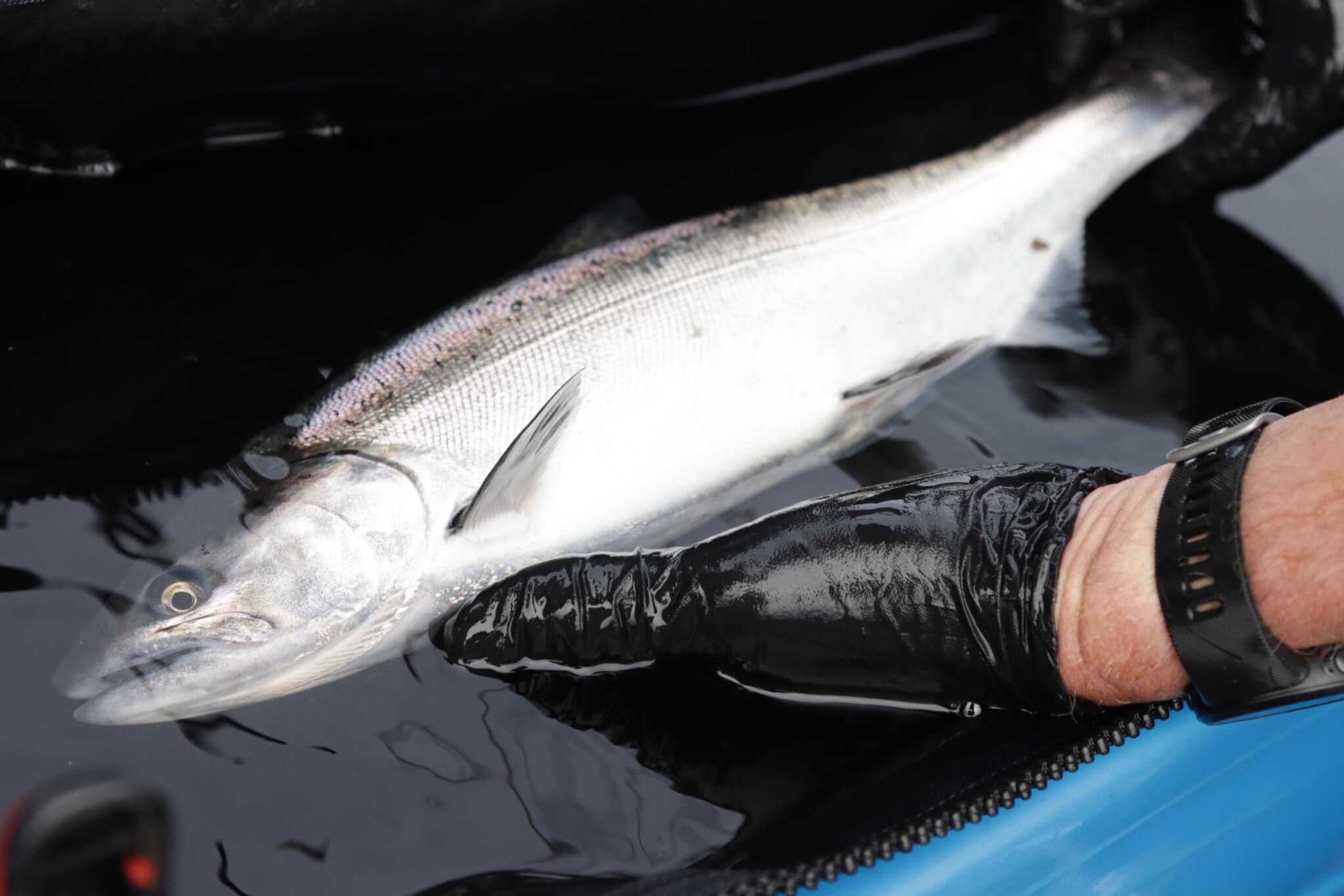
A Chinook salmon caught in the Barkley Sound for research. Photo: UBC Forestry & Environmental Stewardship’s Pacific Salmon Ecology and Conservation Lab
An unexpected discovery
The study wasn’t originally designed to investigate disease. UBC’s Pacific Salmon Ecology and Conservation Laboratory was sampling wild Chinook salmon in 2022 for a study on the impact of recreationally caught and released salmon when some fish started developing skin ulcers and dying unexpectedly.
“This work was novel because it was the first time that marine-captured Chinook salmon had been held for observation longer than three days. A few days into the study, we noticed unusual bacterial lesions developing on some of the fish, just in front of the tail. We reached out to Emiliano, and his team quickly arrived on site to help us determine what was going on,” says Katie Zinn from UBC’s Pacific Salmon Ecology and Conservation Lab, and co-author of the study.
To determine the cause, UBC partnered with the Pacific Salmon Foundation, DFO’s Pacific Biological Station, the University of Toronto, and the University of California, Davis. Using gill sampling, molecular and genetic screening, and histology, the team diagnosed tenacibaculosis and identified T. dicentrarchi as the likely causative bacterium.
“We spend enormous effort trying to understand why wild salmon die in the ocean. This study gives us one of the clearest pieces of evidence that links bacterial disease to mortality in wild Pacific salmon,” says Zinn.
Tenacibaculosis is one of the most common diseases in farmed Atlantic salmon raised in open-net pens in British Columbia, and a leading cause of farm mortality. It has also been found in farmed and hatchery-origin Pacific salmon in California, Chile, New Zealand, and Alaska. Common symptoms include lethargy, loss of balance, abnormal swimming behaviour, skin, fins and oral ulcers, and high mortality.
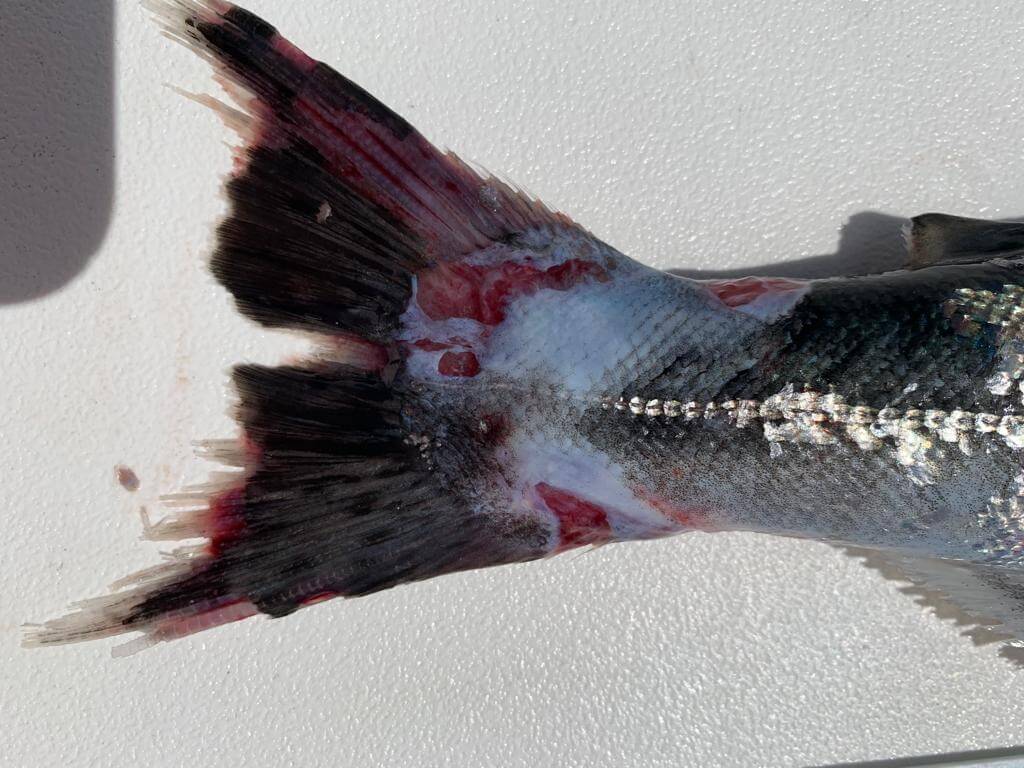
Physical signs of tenacibaculosis include erosion and ulcers in the gills, skin, and fins. Photo: Emiliano Di Cicco
Bacterial origins
T. dicentrarchi, one of many Tenacibaculum bacteria species, occurs naturally in the ocean, but previous research has shown it can become more concentrated around open-net pen salmon farms.
The researchers also note that handling fish during capture and the holding stages of the study may have increased their susceptibility to infection by damaging the protective mucus layer on their skin and fins. Previous research led by UBC’s Pacific Salmon Ecology and Conservation lab has identified several best practices for handling fish that improve their chances of survival.
The authors of the study say the next step is to determine what causes the disease in wild salmon and how fish become infected.
—
About the Pacific Salmon Foundation:
The Pacific Salmon Foundation (PSF), founded in 1987, is a non-profit environmental organization dedicated to making transformational change for the benefit of Pacific salmon at every scale – from the smallest streams to the open ocean. PSF works with partners to achieve our vision of healthy, sustainable, and naturally diverse populations of Pacific salmon for the benefit of ecosystems and people for generations to come.
About the University of British Columbia Pacific Salmon Ecology and Conservation Laboratory:
Based at UBC’s Faculty of Forestry & Environmental Stewardship, the Pacific Salmon Ecology and Conservation Laboratory studies the ecology, behaviour, physiology and conservation of Pacific salmon throughout their life cycle. The lab’s research supports sustainable fisheries management and salmon recovery by advancing understanding of how environmental change, human activities and disease affect salmon survival.
Media contacts
Braela Kwan
Communications Specialist, Pacific Salmon Foundation
604-664-7664
Charlotte Fisher
Marketing & Media Relations Strategist, UBC Faculty of Forestry & Environmental Strategist
604-822-8718

