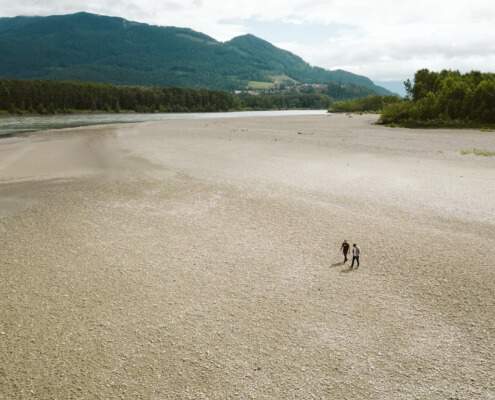
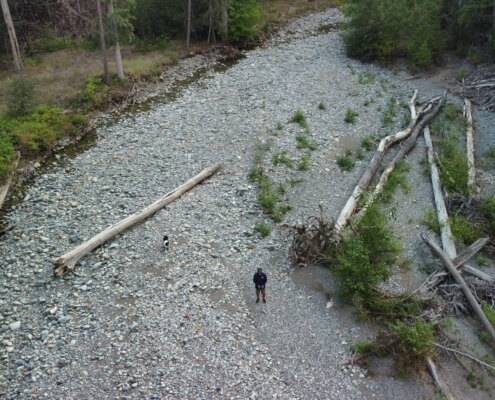
On Vancouver Island, low flows in the Cowichan River are now an ongoing, multi-year problem and remain below what locals expect for the time of year.
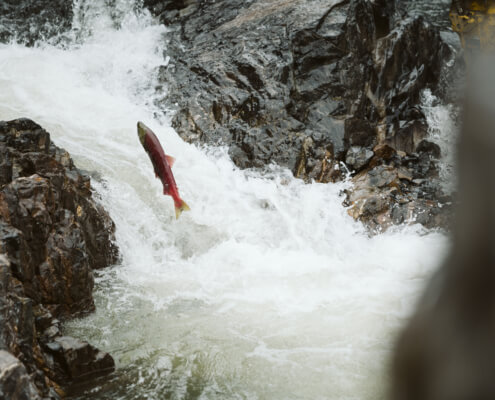
The memory of 2023 – when 80,000 fish died in the system due to drought – looms large for salmon managers. This led to urgent action to build a drought response strategy for the Cowichan, which was supported by a $100,000 grant from the Pacific Salmon Foundation, as well as Cowichan Tribes, the Cowichan Valley Regional District, and provincial and federal funds.
The planning paid off in 2025, when river conditions approached similar levels seen in 2023. Emergency response measures were activated, including reducing wastewater effluent, conserving lake water and closing fisheries early, which all helped prevent another fish die-off.
This year, local salmon leaders are once again ready to respond to any salmon emergencies.
Elsewhere on Vancouver Island, water levels are at critical levels in French Creek and Tsolum River. Water from Wolf Lake reservoir is being released to help maintain flows in the Tsolum. In June, PSF funded $6,000 to BC Conservation Foundation and Snuneymuxw First Nation to rescue young salmon in the Nanaimo River. 5,000 young salmon have already been rescued this year as crews battle exceptionally dry condition in the important salmon system.

 https://psf.ca/wp-content/uploads/2022/11/2023-10-17_Bridge-Rapids_Brandon-Deepwell-39-scaled-e1698911442587.jpg
1294
1940
Oscar Beardmore-Gray
/wp-content/uploads/2022/04/PSF-Logo-2022-min.png
Oscar Beardmore-Gray2023-11-02 00:45:472024-04-15 12:48:08Urgent action allows thousands of salmon to pass through Bridge Rapids
https://psf.ca/wp-content/uploads/2022/11/2023-10-17_Bridge-Rapids_Brandon-Deepwell-39-scaled-e1698911442587.jpg
1294
1940
Oscar Beardmore-Gray
/wp-content/uploads/2022/04/PSF-Logo-2022-min.png
Oscar Beardmore-Gray2023-11-02 00:45:472024-04-15 12:48:08Urgent action allows thousands of salmon to pass through Bridge Rapids