Photos: Brandon Deepwell, Lars Reese-Hansen

With a warmer-than-average summer forecasted and drought conditions already developing, Pacific Salmon Foundation (PSF) is on high alert for adverse impacts on salmon across British Columbia.  

Pacific salmon travel hundreds of kilometres to and from their home rivers to spawn and rely on cool, flowing rivers to make this epic journey.  

Since 2022, the province has faced persistent, multi-year drought conditions because of warm weather, low precipitation and snowpack, and early snowmelt, creating challenging conditions for salmon.  

Early warning signs indicate that 2026 could be worse than in previous years, particularly on the south coast of British Columbia.  

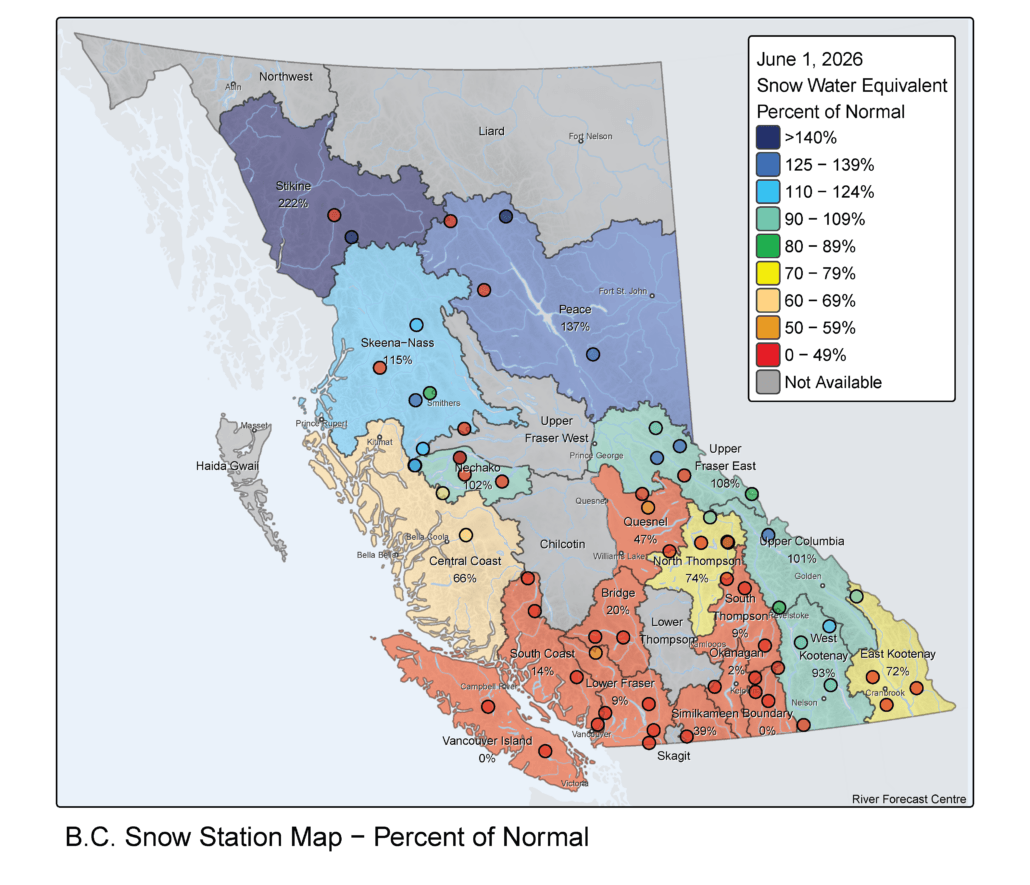
As of June 1, snowpack levels on Vancouver Island sat at 0 per cent of normal amounts and 14 per cent of normal for the South Coast region. Both are significantly less than the levels seen in all previous drought years at the same point in the spring.

A warm winter and low snowpack levels are concerning for salmon in parts of British Columbia going into this summer,” says Jason Hwang, Chief Program Officer, Pacific Salmon FoundationWe know that Pacific salmon struggle in these abnormal conditions. But we’ve learnt from previous years where drought may cause issues, and we’re ready with partners to take action.” 

Early signs of drought emerging  

For a fifth consecutive year, experts are already warning of extreme drought conditions on the Cowichan River on Vancouver Island and in the Okanagan Basin.  

On May 20, Syilx Okanagan Nation formally declared a watershed emergency across its territories in the Southern Interior in response to “accelerating drought, ecosystem decline, and growing threats to water security.” Snowpack is extremely low in the Okanagan region  currently 2 per cent of normal. Critical salmon runs, including at-risk Okanagan sockeye, could be affected by drought. 

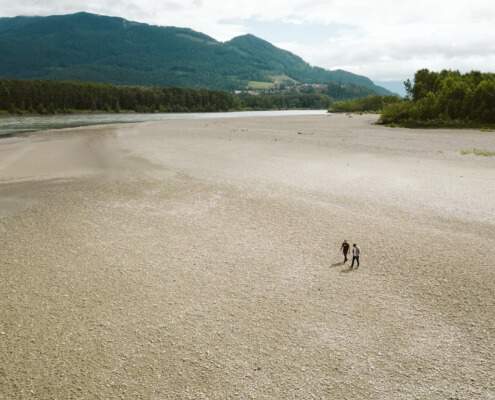
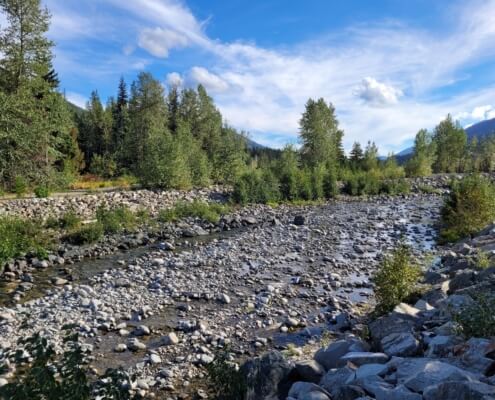
On Vancouver Island, low flows in the Cowichan River are now an ongoing, multi-year problem and remain below what locals expect for the time of year.   

The memory of 2023 – when 80,000 fish died in the system due to drought – looms large for salmon managers. This led to urgent action to build a drought response strategy for the Cowichan, which was supported by a $100,000 grant from the Pacific Salmon Foundation, as well as Cowichan Tribes, the Cowichan Valley Regional District, and provincial and federal funds.  

The planning paid off in 2025, when river conditions approached similar levels seen in 2023. Emergency response measures were activated, including reducing wastewater effluent, conserving lake water and closing fisheries early, which all helped prevent another fish die-off.  

This year, local salmon leaders are once again ready to respond to any salmon emergencies.  

Reporting tools make it easier to track drought  

Pacific Salmon Foundation has partnered with the Province of B.C., First Nations Fisheries Council and Fisheries and Oceans Canada to develop drought reporting tools that make it easier for communities to raise the alarm when drought affects salmon habitat.  

This emergency funding group was formed in 2023 in response to an uptick in climate emergencies affecting salmon. It is designed to help local stewards, including First Nations, streamkeepers, and conservation organizations respond quickly to in-season drought impacts on salmon.   

Since its inception, the emergency funding body has provided $1.8 million to 59 projects across British Columbia. 

This critical resource has been used to boost oxygen levels in the Tsolum River on Vancouver Island, save stranded salmon in the Lower Mainland, and reconnect dried-up streams in the Southern Interior.  

According to polling from BC Watershed Security Coalition, 69 per cent of British Columbians say they are concerned about the potential for a major water crisis in their community.

PSF and the Province of B.C. are also piloting a rapid drought assessment protocol which provides a practical, scalable way to track stream conditions and trigger coordinated drought responses when salmon are put at risk. 

The system helps local stewards to quickly classify streams as ‘red,’ yellow,’ or ‘green’ concern using a standardized scorecard built around key visual checks of flow and habitat conditions. This kind of data will help coordinate emergency operations and guide water use restrictions, fishing closures, and other management measures across the province this summer.  

If you are a member of the general public and would like to report drought in your community this summer, submit information via PSF’s Drought Reporting Tool here.  

If you are part of a community stewardship group or a local fisheries technician, please report drought and reach out for more information by emailing: Recovery.restoration@gov.bc.ca  

Thank you to our generous funding partners: the Province of British Columbia, the Government of Canada, and the Pacific Salmon Endowment Fund. 

Report Drought Affecting Salmon.

If you see drought conditions in your area that are impacting salmon habitat or might be impeding salmon migration, please use the reporting tool.

News and Updates

B.C. forecasts provincial drought this summer. How can we help salmon survive?
,
As the province warns of “long-term, significant drought” this summer, impacts on salmon are imminent. While those exact impacts are to be determined, PSF and partners seek innovative, cost-effective solutions to help salmon adapt.

Emergency funding to protect salmon after spring floods in the Skeena Watershed

,
The Pacific Salmon Foundation has provided $23,700 in funding to support three time-sensitive habitat rehabilitation, fish salvage, and infrastructure repair projects in response to recent flood events across B.C. Unseasonably warm weather…

Drought effects: warm, dry streams impact salmon migrations

, , ,
https://www.youtube.com/watch?v=CbwxvGrLWnI&feature=youtu.be Oct. 07, 2022 (updated with video October 17, 2022) Article written by Katrina Connors, Director of the Salmon Watersheds Program, Pacific Salmon Foundation This week, B.C.’s…